

What Is Best Fastest Way To Clean A Meth Bubble
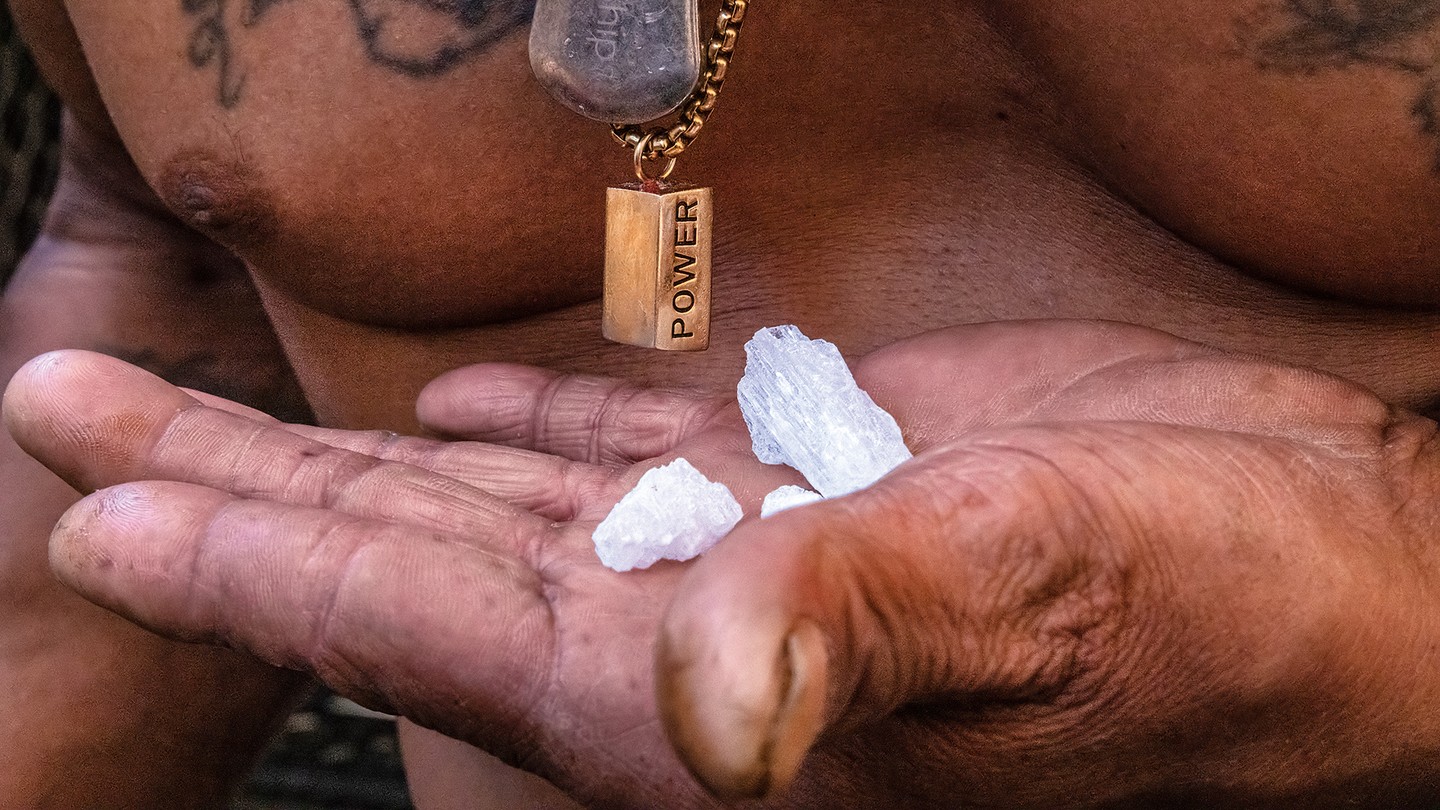
'I Don't Know That I Would Even Phone call It Meth Anymore'
Dissimilar chemically than it was a decade agone, the drug is creating a wave of severe mental illness and worsening America's homelessness problem.
Inorthward the fall of 2006, police force enforcement on the southwest edge of the United States seized some crystal methamphetamine. In due class, a five-gram sample of that seizure landed on the desk-bound of a 31-year-erstwhile chemist named Joe Bozenko, at the Drug Enforcement Administration lab outside Washington, D.C.
Organic chemistry can be endlessly manipulated, with compounds that, like Lego bricks, can be used to build almost annihilation. The field seems to breed folks whose every waking infinitesimal is spent puzzling over chemical reactions. Bozenko, a garrulous man with a wide smile, worked in the DEA lab during the day and taught chemistry at a local university in the evenings. "Chemist by day, chemist by dark," his Twitter bio once read.
Bozenko had joined the DEA seven years before, just as the global underworld was veering toward constructed drugs and abroad from their constitute-based cousins. Bozenko'south job was to empathize the thinking of black-market place chemists, samples of whose work were regularly plopped on his desk. He analyzed what they produced and worked out how they did it. In time, Bozenko began traveling abroad to underground labs after they'd been seized. His first foreign assignment was at a lab that had made the stimulant MDMA in Jakarta, Indonesia. He saw the world through the protective goggles of a hazmat suit, sifting through the remains of illegal labs in three dozen countries.
Meth was the drug that Bozenko analyzed most in the early years of his task. Large quantities of it were coming upward out of Mexico, where traffickers had industrialized production, and into the American Southwest. All of the stuff Bozenko analyzed was made from ephedrine, a natural substance commonly found in decongestants and derived from the ephedra plant, which was used for millennia as a stimulant and an anti-asthmatic. A Japanese researcher had first altered the ephedrine molecule to synthesize crystal methamphetamine in 1919. During World State of war II, information technology was marketed in Japan as hiropon, a word that combines the Japanese terms for "fatigue" and "fly abroad." Hiropon was given to Japanese soldiers to increase alertness.
In the early 1980s, the ephedrine method for making meth was rediscovered past the American criminal earth. Ephedrine was the active ingredient in the over-the-counter decongestant Sudafed, and a long boom in meth supply followed. But the sample that arrived on Bozenko's desk that day in 2006 was not made from ephedrine, which was growing harder to come up past every bit both the U.S. and Mexico clamped down on it.
There was another manner to brand methamphetamine. Before the ephedrine method had been rediscovered, this other method had been used past the Hell's Angels and other biker gangs, which had dominated a much smaller meth merchandise into the '80s. Its essential chemical was a clear liquid called phenyl-ii-propanone—P2P. Many combinations of chemicals could be used to brand P2P. Most of these chemicals were legal, cheap, and toxic: cyanide, lye, mercury, sulfuric acid, hydrochloric acid, nitrostyrene. The P2P procedure of making meth was complicated and volatile. The bikers' cooking method gave off a odor so rank that it could simply exist washed in rural or desert outposts, and the marketplace for their product was limited.
Bozenko tinkered with his sample for ii or three days. He realized information technology had been fabricated with the P2P method, which he had not seen employed. All the same, that was not the most startling aspect of the sample. There was something else about those few grams that, to Bozenko, heralded a changed world.
Among the drawbacks of the P2P method is that it produces two kinds of methamphetamine. One is known as d-methamphetamine, which is the stuff that makes you loftier. The other is l-methamphetamine, which makes the centre race merely does trivial to the brain; it is waste product product. Most cooks would probable want to go rid of the 50-meth if they knew what it was. But separating the two is tricky, beyond the skills of nearly hugger-mugger chemists. And without doing and so, the resulting drug is junior to ephedrine-based meth. It makes your heart hammer without offering as potent a high.
Bozenko's sample contained by and large d-methamphetamine. Someone had removed most of the l-meth. "I've taken downwardly labs in several continents," Bozenko told me years later on. No one in the criminal globe, as far as he and his colleagues knew, had ever figured out how to separate d-meth from l-meth before.
Dorsum in the late '80s and '90s, when the ephedrine method had taken over, the market for meth had grown because of ephedrine'south availability—and because the substance could be transformed into meth with ease and efficiency. All you had to do was tweak the ephedrine molecule, and doing that required lilliputian more than than following a recipe. But you had to have ephedrine.
The P2P method offered traffickers one huge reward: The chemicals that could exist used to make it were also used in a wide array of industries—amid them racing fuel, tanning, gold mining, perfume, and photography. Law enforcement couldn't restrict all these chemicals the way it had with ephedrine, not without damaging legitimate sectors of the economy. And a trained organic chemist could make P2P, the essential ingredient, in many ways. It was impossible to say how many methods of making P2P a creative pharmacist might come up with. Bozenko counted a dozen or so at first. He put them up in a large diagram on his function wall, and kept adding Post-it Notes with new ones equally they appeared.
As Bozenko dissected that sample in 2006, its implications striking him. Drugs made in a lab were not subject to weather or soil or season, only to chemic availability: With this new method and full access to the globe's chemical markets through Mexican shipping ports, traffickers could ramp up product of P2P meth in quantities that were, effectively, limitless.
Even so, Bozenko couldn't take anticipated simply how widely the meth epidemic would attain some 15 years later, or how it would come to interact with the opioid epidemic, which was and then gaining force. And he couldn't know how strongly information technology would contribute to related scourges now very much evident in America—epidemics of mental illness and homelessness that twelvemonth by year are growing worse.
A few months later Bozenko's discovery, on December 15, 2006, in a town named Tlajomulco de Zúñiga in the central-Mexican country of Jalisco, a methamphetamine lab exploded. Firefighters responded to the blaze, at a warehouse where plastic dinnerware had once been made. No 1 was hurt in the burn down, nor was anyone arrested. Just a burn chief called the local DEA office.
Abe Perez supervised the DEA's Guadalajara function dorsum then. The warehouse stood on a cul-de-sac at the stop of a firm-lined street, Perez, who is now retired, remembered years later. Residents "knew something was going on; the smells were giving them headaches," Perez told me. But they were afraid to say anything. So they lived with it as best they could until the warehouse exploded, almost likely because of a worker's abandon.
Perez and his agents urged Mexican constabulary and prosecutors to obtain a search warrant for the building. The process was dull, and the day concluded with no warrant. That night some other burn erupted, at a warehouse beyond the street that, the agents learned, contained chemicals in blue plastic barrels and in bags neatly stacked on pallets. "The traffickers came in the middle of the dark with gasoline and burned it, burned all the evidence," Perez said. "Simply nosotros were able to go photos of the place."
Eduardo Chávez, another DEA agent, flew in from Mexico City the next afternoon. He and Perez stood outside the second smoldering warehouse. Each human had spent the early office of his career busting meth labs in rural California—Chávez in the surface area around Bakersfield, Perez in northeastern San Diego County.
That had been a different era, and each had gotten a rare view into information technology. Bakersfield was Chávez'due south first assignment, in 2000, and to his surprise, it was a hotbed of meth production. Southern California was where the ephedrine-based method had been rediscovered, largely due to the efforts of an ingenious criminal named Donald Stenger. Stenger died in 1988, in custody in San Diego Canton, after a packet of meth he'd inserted in his rectum broke open up. But the ephedrine method had past then become more widely known and adopted by Mexican traffickers moving up and down the declension between United mexican states and California.
The Mexican meth manufacture had been pioneered in that earlier time by two brothers, Luis and Jesús Amezcua. They came to California illegally as kids, and eventually ran an auto shop well-nigh San Diego. The story goes that a local meth melt dropped by their store in about 1988, asking Jesús if he could bring in ephedrine from United mexican states. Jesús at the time was smuggling Colombian cocaine. Just he brought ephedrine north and, with that, became attuned to the market that had been opened by Stenger's innovation.
Ephedrine was so an unregulated chemical in Mexico. Within a few years, the Amezcuas were importing tons of information technology. Jesús traveled to India and Thailand, where he gear up an office to handle his ephedrine exports. Later, his focus shifted to China and the Czech republic.
The Amezcuas' meth career lasted almost a decade, until cases brought against them landed them in a Mexican prison house, where they remain. Merely the brothers marked a new way of thinking amid Mexican traffickers. They were more than interested in business deals and alliances than in the vengeance and countless shoot-outs so common to the previous generation of smugglers, who had trafficked by and large in marijuana and cocaine. The Amezcuas were the first Mexican traffickers to understand the profit potential of a constructed drug, and the start to tap the global economy for chemical connections.
At first, the brothers ran labs on both sides of the border. They set up upward many in California's rural Central Valley—Eduardo Chávez'south territory—making utilize of an existing network of traffickers amid the truckers and migrant farmworkers that stretched upward from San Diego. At ane bust, agents found a man in protective garments with an air tank on his back. He turned out to be a veterinarian from Michoacán who said he came up for four-month stints to teach the workers to melt.
Hell's Angels cooks took three days to make v pounds of meth. Mexican crews soon learned to arrive at cook sites like NASCAR pit crews, with premeasured chemicals, large vats, and seasoned workers. They produced 10 to xv pounds per cook in 24 hours in what came to be known as "super labs." Soon the biker gangs were ownership their meth from the Mexicans.
Just toward the terminate of Chávez's Bakersfield assignment, in 2004, the cooks and workers who'd been coming up from Mexico began to vanish. His informants told him that they were heading home. In California, police force enforcement had made things hard; the job was getting too risky, the chemicals too hard to come past. The meth-cook migration would accelerate after Chávez left the land in 2004. Meth-lab seizures in the United states withered—from more than 10,000 that year to some ii,500 in 2008. Today in the United States, they are rare, and "super labs" are practically nonexistent. In Mexico, however, it was a dissimilar story.
The burned-down lab existence surveyed by Chávez and Perez at the cease of 2006 had been designed to produce industrial quantities of meth. Like many other labs that had been popping up in Mexico, it reflected the union of substantial capital and little concern for law enforcement. It used expensive equipment and stored large inventories of chemicals pending processing. Notes found on the scene suggested that the cooks typically got about 240 pounds per batch.
Like Joe Bozenko, the agents standing at the edge of the smoke and the stench that afternoon felt that they were glimpsing a new drug earth. What struck them both was what they were not seeing. No ephedrine. The lab was gear up exclusively to make P2P meth.
What's more, this lab was not subconscious up in the mountains or on a rural ranch. Tlajomulco de Zúñiga lies just xv miles southward of Guadalajara, 1 of Mexico'southward largest cities, and serves as home to the metropolis's international airport. The area has everything needed to be a eye of meth manufacturing: warehouses, transportation hubs, proximity to chemists. Trucks rumble through the surface area daily from the aircraft ports in Lázaro Cárdenas, in the country of Michoacán, and Manzanillo, in the land of Colima.
The ephedrine method was still very much in employ in 2006; Mexico, which had been reducing legal imports of ephedrine, wouldn't ban them outright until 2008; even after that, some traffickers relied on illegal shipments for a time. And despite all the advances when information technology came to making P2P, in at to the lowest degree some respects the traffickers "didn't know what they were doing still," Chávez told me. The explosion showed that. Even so, years later he idea dorsum on that moment and realized that it was virtually every bit if they were witnessing a shift correct then, that week.
About five years later on the Tlajomulco lab exploded, in June 2022, Mexican regime discovered a massive P2P meth lab in the city of Querétaro, but a few hours n of Mexico City. It was in a warehouse that could have fit a 737, in an industrial park with roads wide plenty for 18-wheelers; it fabricated the Tlajomulco lab look tiny. Joe Bozenko and his colleague Steve Toske were chosen downward from Washington to audit it, and they wandered through it in awe. Bags of chemicals were stacked 30 feet high.
Hundreds of those bags contained a substance neither Bozenko nor Toske had ever thought could be used to make P2P. Bozenko oftentimes consulted a book that outlined chemicals that might serve equally precursors to making methamphetamine, simply this particular substance wasn't in information technology. Well-trained organic chemists were conspicuously improvising new ways to make the ingredients, expanding potential supply even farther.
Working through all the chemicals in the plant, by Bozenko's estimation, the lab could have produced 900 metric tons of methamphetamine. Against a wall stood 3 1,000-liter reactors, two stories tall.
Nothing like this had been achieved with ephedrine, nor could it take been; no one could have imagined the accumulation of 900 metric tons of the chemical. Later, Mexican investigators would report that of the 16 workers arrested at the Querétaro lab, 14 died over the next half-dozen months from liver failure—presumably acquired by exposure to chemicals at the lab.
Methamphetamine was having a cultural moment in the U.S.—"meth oral fissure" had become an object of tin can't-look-abroad fascination on the internet, and Breaking Bad was big. The switch from ephedrine-based labs to ones using the P2P method was fifty-fifty a plot indicate in the series. But few people outside the DEA really understood the consequences of this shift. Shortly, tons of P2P meth were moving north, without whatever letup, and the price of meth collapsed. Merely in that location was more to the story than higher volume. Ephedrine meth tended to damage people gradually, over years. With the switchover to P2P meth, that damage seemed to accelerate, peculiarly damage to the brain.
One nighttime in 2009, in Temecula, California, partway between San Diego and L.A., a longtime user of crystal meth named Eric Barrera felt the dope change.
Barrera is a stocky ex-Marine who'd grown up in the L.A. surface area. The meth he had been using for several years by then made him talkative and euphoric, made his scalp tingle. Just that night, he was gripped with paranoia. His girlfriend, he was certain, had a human in her flat. No one was in the apartment, she insisted. Barrera took a kitchen knife and began stabbing a sofa, sure the man was hiding there. Then he stabbed a mattress to tatters, and finally he began stabbing the walls, looking for this homo he imagined was hiding inside. "That had never happened before," he told me when I met him years later. Barrera was hardly alone in noting a change. Gang-member friends from his old neighborhood took to calling the meth that had begun to circulate in the surface area around that time "weirdo dope."
Barrera had graduated from high school in 1998 and joined the Marine Corps. He was sent to Military camp Lejeune, in Northward Carolina, where he was among the few nonwhite Marines in the platoon. The racism, he felt, was threatening and brazen. He asked for a transfer to Army camp Pendleton, in San Diego Canton, and was denied. Over the adjacent year and a half, he said, it got worse. Ii years into his service, he was honorably discharged.
Subsequently the September 11, 2001, terrorist attacks, Barrera was filled with remorse that he hadn't stuck it out in the Corps. He was abode now, without the heroic story he'd imagined for himself when he joined the Marines. The way he tells it, he drank and used meth to salvage his low.
He'd sometimes stay up on meth for four or 5 days, and he had to make excuses for missing piece of work. Just until that point, he'd held his life together. He worked equally a loan processor, and then for an insurance visitor. He had an apartment, a souped-upwardly Acura Integra, a lot of friends.
But every bit the meth changed effectually 2009, so did Barrera'due south life. His cravings for meth continued, simply paranoia and delusions began to fill his days. "Those feelings of beingness chatty and wanting to talk get away," he told me. "Of a sudden you're stuck and you're in your caput and you lot're there for hours." He said strange things to people. He couldn't concord a task. No one tolerated him for long. His girlfriend, and so his female parent, then his begetter kicked him out, followed past a string of friends who had welcomed him because he ever had drugs. When he described his hallucinations, "my friends were similar, 'I don't intendance how much dope you got, you can't stay here.' "
By 2022, massive quantities of meth were flowing into Southern California. That same year, 96 per centum of the meth samples tested by DEA chemists were made using the P2P method. And, for the get-go time in more than a decade of meth use, Barrera was homeless. He slept in his car and, for a while, in abandoned houses in Bakersfield. He was hearing voices. A Veterans Affairs psychologist diagnosed him with depression and symptoms of schizophrenia.
Fifty-fifty many years later, when I spoke with him, Barrera didn't know how the drug he was using had changed and spread, or why. But as a resident of Southern California, he was among the starting time to exist affected by it. Over the adjacent half-dozen years or and so, the flood of P2P meth would spread east, immersing much of the rest of the land, also.
Mention drug-running, and many people will think of cartels. Nonetheless over the past decade, meth'due south rising availability did not result from the dictates of some underworld board of directors. Something far more powerful was at work, peculiarly in the Sinaloa area: a massive, unregulated free market.
By the time Eric Barrera'due south life began to collapse, something like a Silicon Valley of meth innovation, knowledge, skill, and production had formed in united states along Mexico'southward northern Pacific Coast. The deaths of kingpins who had controlled the trade, in the early 2022s, had only accelerated the procedure. "When the control vanishes, all these regional fiefdoms spring up," said a DEA supervisor who pursued Mexican trafficking organizations during these years. (He, like some other DEA agents I spoke with, asked that his name not be used, because of the dangerous nature of his piece of work.) "We just started seeing more and more labs springing up everywhere." The new labs weren't all as enormous as the Querétaro lab that Bozenko had seen in 2022. But they multiplied quickly.
Commencement in near 2022 and standing for the next several years, meth production expanded geometrically; the labs "just escape all limits," a member of the Sinaloan drug globe told me. "In a v-square-kilometer expanse exterior Culiacán [Sinaloa's upper-case letter city], there were, like, 20 labs. No exaggeration. You lot go out to xv kilometers, there's more than a hundred."
Listening to traffickers on wiretaps, 1 DEA agent told me, made information technology clear just how loose the confederations of meth suppliers were by so. The cartels had not vanished, and many of these suppliers were likely paying 1 or another of them off. Only the wires nonetheless revealed a pulsing ecosystem of contained brokers, truckers, packagers, pilots, shrimp-gunkhole captains, mechanics, and tire-shop owners. In the Usa, the arrangement included meat-plant workers, money-wiring services, restaurants, farm foremen, drivers, safe houses, and used-car lots. The ecosystem harnessed the self-interest of each of these actors, who got paid only when deals got done.
"Nosotros'd waste hours listening on the wire," the agent told me, "to people wasting their time calling effectually doing the networking every bit brokers, trying to prepare drug deals, because they wanted to make money. At that place's a huge layer of brokers who are the driving force [in Mexican drug trafficking]. Perchance they own a business or restaurant in Mexico or in the U.S.—this is something they do to supplement income. A large percentage of drug deals at this level don't happen. But it'south similar salesmen—the more than calls you lot make, the more people you know, the more sales you become. So four or 5 people will be involved in getting 50 kilos to some city in the United states. This guy knows a guy who knows a guy who has a cousin in Atlanta … And with the contained transporters operating at the edge, there's no cartel allegiance. They're all just making money."
From 2022 to 2022, the Mexican armed forces raided some 330 meth labs in Sinaloa alone. Simply arrests were rare, co-ordinate to a person involved in targeting the labs. Far from being a deterrent, the raids showed that no i would pay a personal price, and more than people entered the trade as a result. At one point in 2022, DEA intelligence held that, despite all the raids, at least 70 meth labs were operating in Sinaloa, each with the chapters to brand tons of meth with every melt.
With labs popping up everywhere, the price of a pound of meth fell to nigh $1,000 for the offset time on U.S. streets by the belatedly 2022s—a 90 percent driblet from a decade earlier in many areas. Yet traffickers' response to tumbling prices was to increase production, hoping to make up for lower prices with college volume. Competition among producers also drove meth purity to record highs.
Pot was part of this story too. Equally some American states legalized marijuana, Mexican pot acquirement faltered. Many producers switched to making meth and institute it liberating. Marijuana took months to abound, was bulky, and could rot. "Just with crystal meth," the member of the Sinaloan drug earth told me, "in x days you've made it. It's non every bit bulky as pot, so in two weeks yous're crossing the border with it. Inside two or three months, you're big."
In the Southwest, the drug speedily became more prevalent than e'er. And supply kept flowing east, roofing the country in meth all the fashion to New England, which had almost none before the mid-2010s. Since late 2022, the Midwest and S have seen an especially dramatic shift. Mexican traffickers had never been able to get their hands on plenty ephedrine to cover those regions, only now that was no longer an issue. In place after identify, they made alliances with local dealers to introduce their product.
The Louisville, Kentucky, area is one example. For years, Louisville had a paltry meth market. A pound of it sold for $14,000. And so Wiley Greenhill went to prison. Greenhill was a modest drug dealer in Detroit who had come up to Louisville in 1999, attracted past Kentucky's vibrant street market for pain pills, which were fetching five times what they sold for in Detroit.
He eventually landed at the Roederer Correctional Complex, n of Louisville, where he struck up a friendship with an inmate from California. The inmate'due south male parent, a businessman from Southern California named Jose Prieto, had gotten into debt with the wrong people from Sinaloa. The Sinaloans told Prieto that to settle his debt, he had to sell their meth. Greenhill was given the opportunity to buy it.
Past 2022 Greenhill was out of prison, and the meth began to flow. At first Prieto sent small quantities through the mail. Soon the loads reached 50 to 100 pounds a month, driven east by women Greenhill hired.
Prieto proved eager to get his product out. He fronted Greenhill hundreds of thousands of dollars' worth of meth on the promise that he would be repaid. Tim Fritz, a DEA amanuensis who investigated the Prieto-Greenhill ring, told me, "Jose Prieto would say, 'Whatever you lot need, we got it. Whatsoever you buy, I'll double it. Y'all desire x pounds, I'll give you xx—pay me later.' "
As months passed, the Louisville meth market expanded beyond anything the region had seen before. The trade spread to southern Indiana and nearby counties in Kentucky as the number of customers grew. Other local traffickers began to import meth as well. The toll of a pound of meth savage to about $1,200, less than a tenth of what information technology had been only a few years earlier.
At the MORE Center, a Louisville dispensary set up to care for pain-pill and heroin addicts, patients started coming in on meth. Earlier the Prieto-Greenhill connection, simply ii of counselor Jennifer Grzesik'southward patients were using meth. Inside three years, near 90 percent of new patients coming to the clinic had meth in their drug screen. "I don't remember having whatever homeless people in my caseload before 2022," she told me. But twenty percent of her clients now are homeless.
Greenhill and Prieto were arrested in 2022 and 2022, respectively, and are at present serving lengthy federal-prison terms. They left backside a transformed market. Primed past the new supply, meth demand has exploded, in turn drawing more dealers who take found their ain supply connections. The price of a pound of meth remains low. To compete, some Louisville meth dealers now offer gratuitous delivery; others offer syringes already loaded with liquid meth so users can immediately shoot up. Like partnerships, arrangements, and retail innovations have transformed regional drug markets across the U.S.
Habits, one time entrenched, are hard to change. If they weren't, more than Americans would take quit smoking before long after 1964, when the U.S. surgeon general issued his first report on its risks. American nicotine addicts kept smoking because nicotine had inverse their encephalon chemistry, and cigarettes were everywhere. We stopped people from smoking, argues Wendy Wood, a psychologist at the University of Southern California and the author of a book on habituation, by calculation "friction" to the activeness—making information technology harder to practise or limiting access to supply. We removed cigarette vending machines, banned smoking in public spaces. By adding friction to smoking, we also removed cues that prompted people to smoke: confined where booze, friends, and cigarettes went together, for instance.
Something like the opposite of that has happened with P2P methamphetamine. "Meth reminds me of what alcoholics go through," Matt Scharf, the managing director of recovery programs at Midnight Mission, a Los Angeles treatment center, told me. "There's alcohol everywhere. Meth is now so readily bachelor. There's an availability to it that is non the example with heroin or crack. It'southward everywhere."
All of that meth has been pushed into a market place already softened up by the opioid epidemic. That should not have mattered: Historically, meth and opioid users had been separate groups with dissimilar cultures, and the drugs affect the brain's advantage pathways differently. But as large supplies of P2P meth began to arrive, many opioid addicts already feared for their life. Fentanyl, a dangerous synthetic opioid, was also spreading speedily. For many, Suboxone—which blocks opiate receptors and hence eliminates opioid cravings—was a lifesaver. They use it daily, the manner a middle patient uses daily claret thinners to stay alive. Still the counseling and continuum of care required to support the broader life changes necessary for addiction recovery are ofttimes absent-minded.
Thus, as P2P meth spread nationwide, an unprecedented event took place in American drug employ: Opioid addicts began to shift, en masse, to meth. Meth overdoses have risen rapidly in recent years, but they are much less common than opioid ODs—you lot don't typically overdose and dice on meth; you decay. Past 2022, in the course of my reporting, I was routinely coming into contact with people in Kentucky, Ohio, Indiana, Tennessee, and W Virginia who were using Suboxone to command their opiate cravings from long-standing addiction to pain pills and heroin, while using methamphetamine to get high. Massive supplies of cheap P2P meth had created need for a stimulant out of a market for a depressant. In the process, traffickers forged a new population of mentally ill Americans.
Over the past yr and a one-half, I've talked with meth addicts, counselors, and cops around the state. The people I spoke with told me stories near identical to Eric Barrera'due south: P2P-meth utilize was rapidly causing steep deterioration in mental health. The symptoms were ever similar: violent paranoia, hallucinations, conspiracy theories, isolation, massive retention loss, jumbled speech. Methamphetamine is a neurotoxin—it damages the brain no matter how it is derived. Just P2P meth seems to create a higher society of cerebral ending. "I don't know that I would even phone call it meth anymore," Ken Vick, the manager of a drug-treatment middle in Kansas Urban center, Missouri, told me. Schizophrenia and bipolar disorder are afflictions that begin in the immature. Now people in their 30s and 40s with no prior history of mental disease seemed to be going mad.
Portland, Oregon, began seeing the overflowing of meth around 2022. By Jan 2022, the urban center had to close its downtown sobering station. The station had opened in 1985 as a place for alcoholics to sober up for six to eight hours, only it was unequipped to handle people fond to P2P meth. "The degree of mental-wellness disturbance; the wave of psychosis; the profound, profound disorganization [is something] I've never seen before," Rachel Solotaroff, the CEO of Central City Concern, the social-service nonprofit that ran the station, told me. Solotaroff was among the starting time people I spoke with. She sounded overwhelmed. "If they're not raging and agitated, they tin exist completely noncommunicative. Treating habit [relies] on your ability to have a connexion with someone. But I've never experienced something similar this—where there'south no mode in to that person."
On Skid Row in Los Angeles, crack had been the drug of pick for decades. Dislodging it took some time. Simply by 2022 the new meth was everywhere. When that happened, "information technology seemed that people were losing their minds faster," a Los Angeles Police Department beat officer named Deon Joseph told me. Joseph had worked Skid Row for 22 years. "They'd be okay when they were simply using crack," Joseph said. "Then in 2022, with meth, suddenly they became mentally sick. They deteriorated into mental illness faster than I ever saw with crack cocaine."
Susan Partovi has been a physician for homeless people in Los Angeles since 2003. She noticed increasing mental illness—schizophrenia, bipolar disorder—at her clinics effectually the city starting in near 2022. She was soon astonished by "how many severely mentally ill people were out there," Partovi told me. "Now most everyone we meet when we practice homeless outreach on the streets is on meth. Meth may now be causing long-term psychosis, similar to schizophrenia, that lasts even later on they're not using anymore."
I chosen James Mahoney, a neuropsychologist at West Virginia University who had studied the furnishings of ephedrine meth on the brain in the early 2000s at UCLA. The psychosis he saw then was bad, he said, but it frequently appeared to exist the result of extended slumber deprivation. In 2022, Mahoney took a task equally a drug researcher and specialist in WVU's addiction clinic. Less than a year later, the P2P crystal meth from Mexico started showing up. Mahoney was inundated with meth patients who came in ranting, conversing with phantoms. "I can't fifty-fifty compare information technology to what I was seeing at UCLA," he told me. "Now we're seeing it instantaneously, within hours, in people who simply used: psychotic symptoms, hallucinations, delusions."
In community later customs, I heard stories like this. Southwest Virginia hadn't seen much meth for almost a decade when suddenly, in about 2022, "we started to see people go into the state mental-infirmary organisation who were just grossly psychotic," Eric Greene, so a drug counselor in the area, told me. "Since and so, information technology's acquired a crisis in our country mental-health hospitals. It'southward difficult for the truly mentally ill to go care because the facilities are total of people who are on meth."
Symptoms could fade one time users purged the drug, if they did not relapse. Only while they were on this new meth, they grew antisocial, all simply mute. I spoke with 2 recovering meth addicts who said they had to relearn how to speak. "It took me a twelvemonth and a half to recover from the brain damage it had done to me," one of them said. "I couldn't hardly form sentences. I couldn't laugh, smile. I couldn't think."
I spoke with Jennie Jobe, from rural Morgan County, in eastern Tennessee. Jobe had spent xx years working in state prisons when she started a drug court and associated residential handling center in 2022.
For its first few years, Jobe's court handled meth addicts who got their drugs from local "shake and bake" manufacturers— small-batch cooks using Sudafed, and usually producing just a few grams of the drug at a time. These meth users were gaunt, she remembers, and picked at their skin. Only they were animated, lucid, with memories and personalities intact when they arrived at her facility, detoxed after months in jail.
By 2022, however, people were coming to her treatment eye stripped of homo energy, fifty-fifty after several months spent detoxing from the drug in jail. "Normal recreational activities where guys talk trash and accept fun—in that location's none of that. It's similar their brain cannot fire."
Treating them was daunting. Despite years of research, scientific discipline has found no equivalent of methadone or Suboxone to help subdue meth cravings and allow people addicted to the drug a chance to intermission from it and begin repairing their life. And, like many others I spoke with, Jobe found that the human connectedness essential to successful drug treatment was almost impossible to plant. "It takes longer for them to actually be here mentally," Jobe said. "Earlier, we didn't keep anybody more than nine months. Now we're running up to 14 months, because information technology's not until six or ix months that we finally find out who we got." Some tin can't remember their life before jail. "It'south not unusual for them to ask what they were found guilty of and sentenced to," she said.
Why is P2P meth producing such pronounced symptoms of mental illness in and so many people? No one I spoke with knew for sure. One theory is that much of the meth contains residuum of toxic chemicals used in its production, or other contaminants. Even traces of certain chemicals, in a relatively pure drug, might be devastating. The sheer number of users is up, too, and the abundance and low price of P2P meth may enable more than continual use among them. That, combined with the drug'southward potency today, might advance the mental deterioration that ephedrine-based meth can also produce, though commonly over a catamenia of months or years, not weeks. Meth and opioids (or other drugs) might also collaborate in particularly toxic means. I don't know of any study comparing the behavior of users—or rats for that matter—on meth made with ephedrine versus meth made with P2P. This now seems a crucial national question.
Once your eyes are open to the scale and human consequences of the P2P-meth epidemic, it'southward difficult to miss its ramifications in many areas of American public life.
Perhaps the most significant is homelessness.
In 2022, a Los Angeles Superior Courtroom gauge, Craig Mitchell, founded L.A.'due south Skid Row Running Club. Every Monday, Thursday, and Saturday, 20 to 50 people—recovering addicts, cops, public defenders, social workers—meet around dawn in front of a local shelter to run for an hour through the greatest concentration of homeless people in the United States. The club's broader mission is to support the area's homeless community through mentorship and a focus on wellness.
Los Angeles has long been the nation'south homelessness capital, but equally in many cities—big and modest—the problem has worsened greatly in contempo years. In the L.A. expanse, homelessness more than than doubled from 2022 to 2022. Mitchell told me that the most visible homelessness—people sleeping on sidewalks, or in the tents that now crowd many of the city's neighborhoods—was conspicuously due to the new meth. "There was a body of water change with respect to meth being the main drug of option kickoff in well-nigh 2008," he said. Now "it's the No. one drug."
Remarkably, meth rarely comes up in urban center discussions on homelessness, or in newspaper articles about it. Mitchell called it "the elephant in the room"—nobody wants to talk about information technology, he said. "There'southward a desire non to stigmatize the homeless as drug users." Policy makers and advocates instead adopt to focus on L.A.'s price of housing, which is very high merely hardly relevant to people rendered psychotic and unemployable by methamphetamine.
Addiction and mental illness have ever been contributors to homelessness. P2P meth seems to produce those weather quickly. "It took me 12 years of using earlier I was homeless," Talie Wenick, a counselor in Bend, Oregon, who began using ephedrine-based meth in 1993 and has been clean for 15 years, told me. "Now inside a year they're homeless. And then many homeless camps have popped up effectually Central Oregon—huge camps on Bureau of Land Management land, with tents and campers and roads they've cleared themselves. And nigh everyone's using. You're trying to help someone get make clean, and they live in a military camp where about anybody is using."
Eric Barrera is now a member of Judge Mitchell'due south running club. Through the VA, he got treatment for his meth habit and constitute housing; without meth, he was able to keep it. The voices in his head went away. He volunteered at a treatment centre, which eventually hired him as an outreach worker, looking for vets in the encampments.
Barrera told me that every story he hears in the course of his piece of work is circuitous; homelessness, of class, has many roots. Some people he has met were disabled and couldn't work, or were but out of prison house. Others had lost jobs or health insurance and couldn't pay for both rent and the surgeries or medications they needed. They'd scraped by until a landlord had raised their rent. Some kept their cars to sleep in, or had welcoming families who offered a couch or a bed in a garage. Barrera thought of them as invisible, the hidden homeless, the shredded-safe-net homeless.
But Barrera as well told me that for a lot of the residents of Skid Row's tent encampments, meth was a major reason they were in that location and couldn't leave. Such was the pull. Some were addicted to other things: crack or heroin, alcohol or gambling. Many of them used any drug available. Merely what Barrera encountered the most was meth.
Tents themselves seem to play a part in this phenomenon. Tents protect many homeless people from the elements. But tents and the new meth seem made for each other. With a tent, the user tin retreat not just mentally from the world but physically. Encampments provide a customs for users, creating the kinds of environmental cues that the USC psychologist Wendy Woods finds crucial in forming and maintaining habits. They are often places where addicts abscond from treatment, where they can find blessing for their meth use.
In Los Angeles, the city'south unwillingness, or inability under judicial rulings, to remove the tents has allowed encampments to persist for weeks or months, though a recent law allows for more proactive action. In this surround, given the realities of addiction, the worst sorts of exploitation have sometimes followed. In 2022, I spoke with Ariel, a transgender adult female then in rehab, who had come to Los Angeles from a small suburb of a midsize American city 4 years earlier. She had arrived hoping for gender-confirmation surgery and saddled with a meth habit. She eventually ended up alone on Hollywood'due south streets. "There's these camps in Hollywood, on Vine and other streets—singled-out tent camps," she said, where women on meth are commonly pimped. "A lot of people who aren't homeless have these tents. They come from out of the area to sell drugs, motion guns, prostitute girls out of the tents. The last guy I was getting worked out past, he was charging people $25 a night to utilise his tents. He would requite you girls, me and iii other people. He'd accept the money and nosotros'd get paid in drugs."
Megan Schabbing, a psychiatrist and the medical director of emergency psychiatric services at OhioHealth, in Columbus, Ohio, subsequently described to me how meth use and this sort of suffering tin can reinforce each other. Schabbing spends much of her fourth dimension on the job earthworks into the underlying causes of drug apply among those who stop up in the ER. Often in that location was trauma: beatings, molestation, rape, war deployment, babyhood chaos, neglect. For many of these patients, she discovered, the delusions fueled by meth became the bespeak—the drug'south attraction. "Many would tell me, 'I tin stay out of reality on the street' " by using meth, she said. "When they come up to us, it takes them days to figure out who and where they are. But some patients have told me that's non a bad affair if you're on the street."
If P2P meth pushed her patients toward homelessness, it too helped them deport it.
How could this crisis emerge then quietly and remain, in many ways, invisible to most Americans? Ane reason, perhaps, is the national focus on the opioid epidemic, which was itself ignored for a long time. In recent years, the headlines take been about pain-pill or heroin overdoses, and so fentanyl overdoses, and the funding has followed. Too, deaths, however tragic, let for memorials, a gamble to remember the deceased's better days. Meth doesn't impale people at most the same rate equally opioids. It presents, instead, the rawest face of living addiction. That part of addiction, one counselor told me, "people don't want to touch it."
At that place is no central villain in the P2P-meth story—no Purdue Pharma, no dominant cartel. At that place'south no unmarried entity to target, either. Then the result is often enveloped in a willful myopia. Advocates for homeless people seem reluctant to speak out near the drug, for fear that the downtrodden will be blamed for their troubles.
The spread of P2P meth is part of a larger narrative—a shift in drug supply from plant-based drugs such equally marijuana, cocaine, and heroin to synthetic drugs, which can be made anywhere, quickly, cheaply, and year-circular. Hole-and-corner chemists are continually seeking to develop more potent and addictive varieties of them. The use of mind-altering substances by humans is age-old, merely nosotros accept entered a new era.
Drug demand is important in this new era. People need to understand what these drugs will ultimately do to them, and those who are using will need substantial assistance getting off them.
Merely it must exist said: The story of the meth epidemic (like the opioid epidemic before it) begins with supply. In a previous era, nigh Vietnam vets kicked heroin when they got abode and were far from state of war and the potent supplies they were used to in Southeast Asia. Today, supplies of meth are vast and cheap throughout much of the state.
Crystal meth is in some ways a metaphor for our times—times of anomie and isolation, of paranoia and delusion, of communities coming apart. Meth is not responsible for these much wider social problems, of form. Simply the meth epidemic is symptomatic of them, and likewise contributes to them.
If you lot spend time among meth users, you'll observe certain habits and tics: fixations on flashlights, for instance, and on bicycles, which are endlessly disassembled and assembled once more. Hoodies are everywhere. The hoodie is versatile—cheap, warm, functional. But every bit opioids, then meth, spread across America, the hoodie likewise became, for many, a hiding identify from a harsh world. "When nosotros put up that hood," one recovering addict told me, "nosotros're making the choice to separate ourselves from everyone else—instead of someone pushing usa out. I think it's our manner to hibernate from the globe that doesn't accept us. The hood is the refuge. It'south our safe identify."
Maybe the best defence force confronting epidemics similar this one lies in choosing to expect more than closely and more sympathetically at the people in those hoods—to put a higher priority on community than we've done in recent years. America has fabricated itself more vulnerable to scourges, even as those scourges grow more potent. Merely scourges are as well an opportunity: They call on usa to reexamine how we live. Until we begin to look out for the most vulnerable amongst u.s.a., there'southward no reason to expect them to allay.
This article is adapted from Sam Quinones'southward new book, The To the lowest degree of United states: Truthful Tales of America and Hope in the Fourth dimension of Fentanyl and Meth. Information technology appears in the November 2022 print edition with the headline "The New Meth." When y'all buy a book using a link on this page, we receive a commission. Cheers for supporting The Atlantic.

Source: https://www.theatlantic.com/magazine/archive/2021/11/the-new-meth/620174/
Posted by: clarktherul.blogspot.com
0 Response to "What Is Best Fastest Way To Clean A Meth Bubble"
Post a Comment